When my daughter-in-law asked me to babysit for the weekend, I didn’t hesitate. There was never a question of whether I would help—it was simply understood. Time with my grandson Oliver was something I treasured, not something I measured. I imagined a weekend filled with the small, ordinary joys that make up the heart of family life: laughter echoing through the house, sticky hands reaching for mine, bedtime stories read a few extra times just because he asked. I expected tiredness, yes—but the kind that feels meaningful, the kind that comes from giving your time to someone you love.
Oliver greeted me with excitement the moment I walked through the door, his tiny arms wrapping around me as if no time had passed since we last saw each other. We spent hours building towers only to knock them down again, laughing each time as though it were the first. We read his favorite story—over and over—until I could practically recite it without looking at the pages. I cooked his meals, making sure they were just the way he liked them, even when it meant extra effort. I cleaned up spills, wiped tears, changed diapers, and handled every small need that came with caring for a child.
When night came, I stayed awake longer than I had in years, rocking him gently after a nightmare. His small voice calling out in the dark reminded me how vulnerable children are, how much they rely on the people around them for comfort and safety. I held him until he fell back asleep, whispering reassurances, feeling that quiet sense of purpose that only comes from being there when someone truly needs you.
It was tiring, yes—but it was also deeply fulfilling.
By Sunday evening, when Lila and Lucas returned, relaxed from their time away, I felt a quiet satisfaction. I helped them settle back in, shared a few updates about Oliver’s weekend, and said my goodbyes. As I drove home, I felt full—not of pride, but of contentment. I had done what family does. I had shown up.
I didn’t expect anything in return.
The next morning, everything shifted.
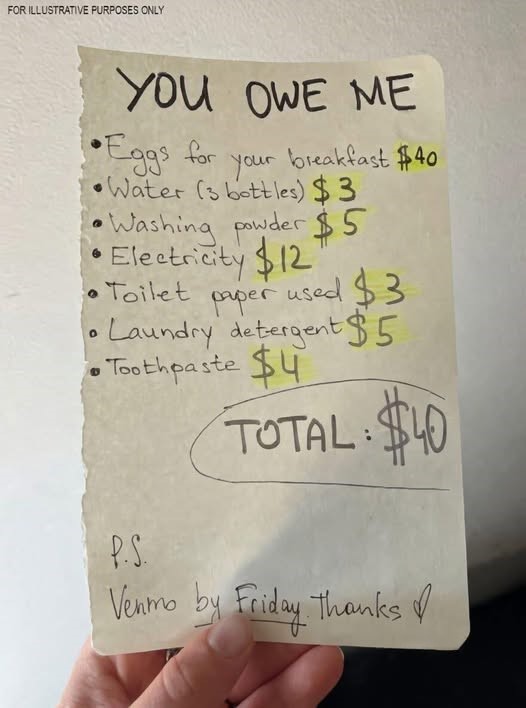
As I stood in my kitchen, preparing coffee, my phone buzzed. It was a message from Lila. I opened it casually, expecting perhaps a photo of Oliver or a simple thank-you. Instead, I saw an image that stopped me cold.
It was a handwritten note.
At first glance, it looked harmless—neatly written, organized, even polite. But as I read it, my confusion turned into disbelief. It was a list of charges. Eggs I had used for breakfast. Bottled water. Laundry detergent. Electricity. Even basic items like toothpaste and toilet paper. Each item had a small cost assigned to it, carefully calculated, with a total circled at the bottom.
Forty dollars.
And beneath it, a polite note requesting payment by Friday.
I stood there, staring at my phone, trying to process what I was seeing. It felt surreal, as though I had stepped into a situation that didn’t belong to me. But the longer I looked, the more real it became. My hands began to tremble—not because of the amount, but because of what it represented.
It wasn’t about money.
It was about meaning.
In that moment, everything I had given over the weekend—my time, my energy, my care—felt reduced to something transactional. Something that could be itemized and charged. It felt like a dismissal of what I had offered, as though my presence had been nothing more than a service provided.
The hurt came quickly.
Anger followed just as fast.
But beneath both of those emotions was something deeper—a sense of being unappreciated, unseen. I had not expected praise or reward, but I had expected respect. And that note felt like the absence of it.
For a brief moment, I considered reacting immediately. Calling, confronting, letting my frustration spill out. But something stopped me. Perhaps it was experience. Perhaps it was the understanding that reacting in anger rarely leads to resolution.
So instead, I chose something else.
I chose to respond.
But not in the way she expected.
I sat down at my kitchen table and took out a piece of paper. If she had chosen to express her perspective through a handwritten note, then I would do the same. But my note would not be about items or costs. It would be about value.
At the top of the page, I wrote: “You Owe Me.”
Then I began listing.
Not eggs. Not water. Not electricity.
I listed time.
I listed patience.
I listed the hours spent comforting a child in the middle of the night. The meals prepared with care. The emotional presence required to ensure that Oliver felt safe, loved, and supported. I wrote about the invisible work—the kind that cannot be measured, the kind that often goes unnoticed because it is given freely.
For each item, I assigned a symbolic value—not because I expected payment, but because I wanted to reflect the reality that what I had given was far more meaningful than anything listed on her note.
At the bottom, I wrote a total.
A number far greater than forty dollars.
But then I added something important.
A note explaining that these things—love, care, time—are not meant to be billed. That family is not a transaction. That what we give to one another should not be reduced to numbers on a page.
I ended it with an invitation to talk—not through notes, but face to face.
When I delivered the note, I felt a mixture of emotions. There was a sense of nervousness, but also a sense of empowerment. For the first time in a long while, I had chosen to express my feelings clearly, without minimizing them.
The response came quickly.
Lila called, her voice filled with emotion. She accused me of overreacting, of making something small into something much bigger than it needed to be. But I remained calm. I explained how her note had made me feel. Not angry—hurt. Not offended—dismissed.
For a moment, there was silence.
Then, slowly, the conversation shifted.
Lucas reached out later, apologizing. He acknowledged that they hadn’t considered how their actions might be perceived. That they had taken my help for granted.
Over the following weeks, we talked more.
Not just about the note, but about everything beneath it.
We uncovered misunderstandings that had been building quietly over time. Differences in expectations. Unspoken frustrations. Lila admitted that her decision had been influenced by stress—financial pressures, the challenges of balancing work and motherhood. In her mind, she had begun to see everything through a practical lens, including my help.
But what she hadn’t realized was how that perspective affected me.
And I admitted something too—that I had felt undervalued in small ways long before this incident, but had never spoken up.
Those conversations were not easy.
But they were necessary.
We began to establish new boundaries. Clear expectations. Open communication. And most importantly, a renewed sense of appreciation for what each of us contributed.
Over time, things changed.
Not dramatically, but steadily.
Gratitude became more visible. Respect became more intentional. And the tension that had once existed began to ease.
Looking back, what started as a shocking and hurtful moment became something else entirely.
A turning point.
It forced us to confront the way we viewed each other—not just as family, but as individuals with needs, expectations, and emotions that deserved acknowledgment.
It reminded me of something important.
That love should never be measured.
But respect should always be present.
And sometimes, the most uncomfortable moments are the ones that lead to the greatest growth.
Today, when I spend time with Oliver, there are no notes. No calculations. No unspoken tensions.
Just laughter.
Just presence.
Just the quiet understanding that some things in life—especially those rooted in love—are beyond value.
And should remain that way.